
When I started this blog, I was determined that while books would be the primary focuses of my reviews, I also wanted to review other things that I loved. These include movies, TV shows and Broadway musicals. And while I will get back to the books soon, I wanted to take the rest of this week to talk about some of my favorite shows.
Broadway musicals are very different when it comes to reviewing them and understanding them. . Unlike books, which you can judge on their own or as part of a series, Broadway shows have to be judged on their own merit. And while they are still judged on characters and plot, new elements are added to the review. Elements such as music, set design and costumes. All of these add a different layer to the story and each show is filled with their own blend of charm, style and sophistication.
Now some of the shows I plan on reviewing have also been turned into movies which makes the review process more intriguing. Movie adaptations have a very mixed history. There have been those that have achieved rousing success, adaptations such as the Academy Award winner My Fair Lady. Others, such as the recent adaptation of Andrew Lloyd Weber’s Cats, have failed spectacularly. But regardless, comparing the movie versions to their stage versions is unavoidable.
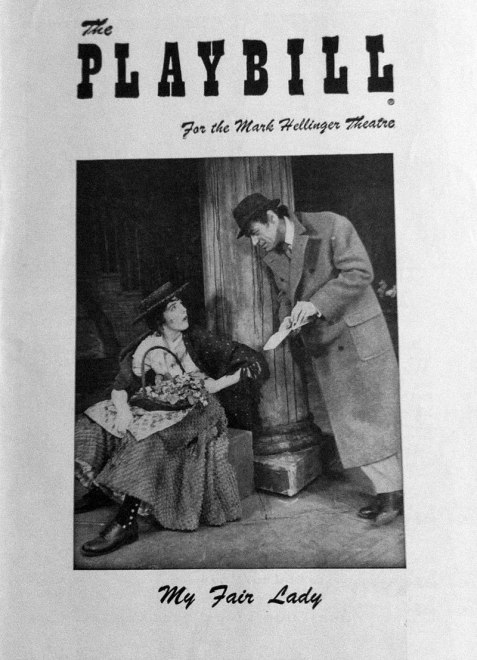
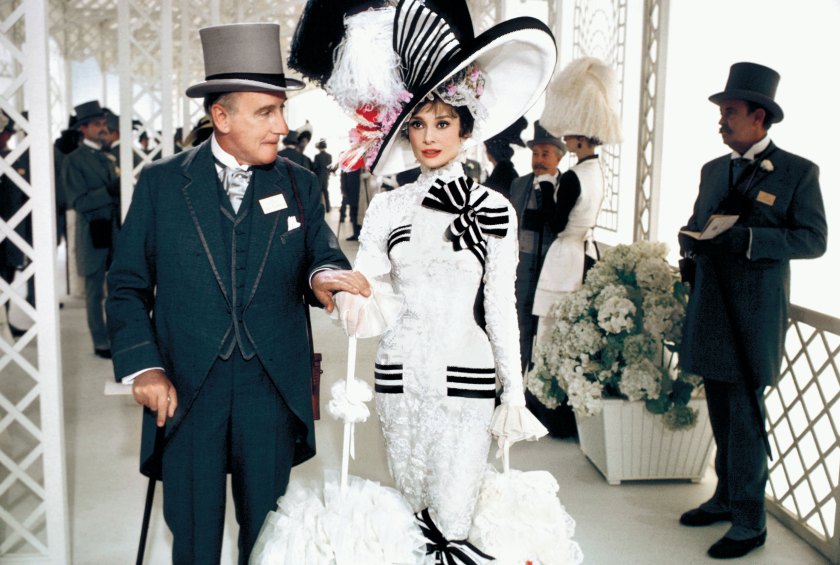
The first show that I will review is one of my favorites, even if I have only seen the movie version. My Fair Lady is one of the most famous and acclaimed shows in the Broadway catalog. The show originally opened in 1956, with Julie Andrews staring as Eliza Doolittle and Rex Harrison as Professor Henry Higgins. The show went on the become one of the highest grossing shows of all time. The show was nominated for 10 Tony Awards (the theater equivalent of the Oscars) and won 6, including Best Musical and Best Performance by a Leading Actor. In 1964, Warner Bros. decided to make a film adaptation of the film. The film drew criticism for a couple of reasons. First, Warner’s decision to cast Audrey Hepburn in the role of Eliza instead of Julie Andrews was the biggest. Warner wanted a big name star and since Andrews had never had a film role before, he was wary. Much to the displeasure of Hepburn, Marnie Nixon ended being the singing voice of Eliza. Ironically, Andrews would go onto win the Oscar for Best Actress or her role in Mary Poppins that same year, beating out Hepburn. Despite all of that, the film won 8 Oscars including Best Picture, Best Actor and Best Director. The musical received a Broadway revival that again won good praise. The revival received 10 Tony Award nominations although it only won one. Now with the history lesson out of the way, onto to the show itself.
The plot of show centers around professor Henry Higgins, a noted phonetician, and his attempts to turn Eliza Doolittle, a Cockney flower girl with unintelligible accent, into a high society girl. Alongside Colonel Pickering, another linguist, Higgins makes the bet that he can pass Eliza off as a Duchess at an upcoming Embassy Ball. Eliza is for this because she sees this an opportunity to escape the streets where she sells her flowers. What follows is a heartwarming, emotional and at times hysterical journey for Higgins, Eliza and Pickering. At first, Eliza struggles with the adjustment and the lessons in general. Higgins is rough, brash and incredibly harsh on Eliza early on which causes Eliza to hate Higgins. Pickering on the other hand, treat Eliza with a much gentler hand.
But as Eliza begins to make progress, even Higgins lightens up on her. But the more Eliza grows into her new place as a Lady, she begins to question many things. After the penultimate scene at the Embassy Ball, Eliza comes to realize she was just a pawn. What follows is the true heart of both the film and the musical. Higgins realizes Eliza meant far more to him than he first realized. I course will not give away the end but let’s just say the finale is truly worth it.
As with most musicals, there are side stories that go hand in hand with the main story. Chief among these is the story of Eliza’s father, Alfred Doolittle. Alfred spends his days drinking and getting money from Eliza. But when Eliza goes to live with Higgins for the duration of the experiment, Alfred sees an opportunity to have more money than ever. However, when Alfred goes to retrieve Eliza, he finds himself nominated as a great philosopher by Higgins. Higgins does it more as joke than anything, but it turns out in a surprising manner for Alfred. Again, I will not spoil that outcome.
The story is one of the great strengths of the show and movie version, but the music is also a massive plus. A musical is defined chiefly by its music and My Fair Lady has some of the best music around. Songs such Wouldn’t It Be Lovely, I Could Have Dance All Night, A Hymn To Him and others are some of the best compositions in the Broadway catalog.
As for the characters, again they are some of the best. Eliza is funny, determined and charming all at once. Higgins is at first an unlikable character, but really turns into a character you love by the end of the show. The rest of the characters are lovable and charming in their own right. Pickering, Freddy, Mrs. Higgins, Alfred Doolittle, all of them are charming, unique and excellent foils to the leads of Higgins and Eliza.
There is so much more that could be talked about regarding this show. The scenes of the Embassy Ball, the scene at the racetrack and many other scenes help to make this musical truly one of a kind.
Everything about this show is truly fabulous. Weather it is the original production with Julie Andrews, the 1964 film version with Audrey Hepburn, the new revival or another production in between, My Fair Lady truly stands out in the annals of Broadway history. There is a reason that it has been called the perfect musical.
Verdict: The highest of 5 stars. A truly great musical and one of the best in the history of the stage.
 The Reader's Corner
While I agree with most of your insights here, I must disagree one one point. I understand the need for a conflict character, my opinion has always been that Freddy is a very unneeded character and that the play would’ve done just as well without him. Or they needed to expand his character to a greater depth. Either way, it remains one of my top 5 plays ever
LikeLike
That’s a very fair point. I’ve gone back and forth on his character for quite some time. I can definitely see how his character could be seen as an unneeded character though
LikeLike